|
The Journal of Ashok Sharda One More Try: April 6th, 2005
04/27/2005 06:17 p.m.
I know what must be done, but knowing on an intellectual plane isn’t enough unless this knowing is thoroughly internalized to the extent that it becomes
almost an obsession and is applied in ACTION. I know I must remember to remember, but how do I remember to remember to remember? It’s not a joke. I am serious. I am frustrated. This is an almost irresolvable problem I have been facing ever since I KNOW that I know and resolved to remember to remember.
Nature is against intentional remembering. The LAW is for remembering subject to the LAW OF ASSOCIATION. Associations with the external cause desires; thoughts having associations with the desires cause thoughts that cause desires, all on their own, caused by the external stimuli’s. But as I know of these LAWS, The LAW OF ASSOCIATION is always subject to THE LAW OF REPETITION. The more a suggestion is repeated, the more it tends to create associations, and associations are the energy sources of all the selves, desired or undesired. This is why I think I should make this endeavor to BE an obsession on my part and put it into action by remembering, that is, by registering post remembering suggestions and by repeating and creating as many associations as I can.
When I say “I”, I mean my INTENTIONAL I. But creating associations isn’t enough. It’s not enough because we all tend to remember and act mechanically if we repeat the same thing again and again. The act it self becomes mechanical, like when you learn to drive a car and this process becomes mechanical in due course of time. So, I must remember to remember, and for this I need to live from moment to moment active, alert, and alive. For this to happen I must remember to remember that I must live from moment to moment active, alert, and alive to vouch for my self that I don’t come up with some trick that lures myself away.
Yes, one is required to remain active, alert, and alive to counter the onslaught of the Nature and its LAWS that shall never allow you to BECOME. Well, I will give one more try, and if I fail, I will give one more……and one more. I am left with no choice, I am condemned to live. So, I shall LIVE to the best of my ability.
Comments (0)
What Matters Then? I Am Still Wondering: April 5th, 2005
04/26/2005 05:26 p.m.
A 'soul mate' of my friend told her the other day that if he is not 'insistent', it's because of my friend’s husband, who happens to be his friend by virtue of being my friend's friend. And here I wonder. I wonder as to why my friend, her very BEING, her inclination, her responses, her choice based on her past and present, matters nothing and what matters is her husband and his friendship with the husband, who happens to be his friend by virtue of being her friend. When there's a projection there's something being shrouded, hidden. I wonder what's hidden behind this projection of not being 'insistent'? Is it frustration? Would he ever think of her husband if my friend responded positively? Would he think of this so-called friendship with her husband if she had given him the desired lift? Would he? We all know the husband would matter not. Neither would the “soulmate’s” soul. Nor would the “soulmate's” entity, her very BEING. What matters then? Where's the soul communicating with the “soulmate’s” soul? Ha! Ha! Ha! But I am still wondering.
Comments (0)
I Did Something Very Funny Today: April 4th, 2005
04/26/2005 02:03 p.m.
I did something very funny today. I tried to understand those rising heartbeats in a very mechanical way. I had a purpose and the purpose was purely technical. I wanted a metaphorical verbalization of this utter physical experience, as my hands would sense and register this sensing. 'Hard sponge-like, but smooth and alive,' is all I could think to describe the experience I had the other day, though not at the actual moment of experience. I wasn't there. The experiencer was so merged with the experience that it never occurred to me how it felt in the technical sense, or if it could be verbalized. But much later and in retrospect, it occurred to me that the experience was unique and did feel like a 'living, hard, smooth sponge'. I also realized that I am not an experienced person in these matters and I had never thought of giving technical words to the physical sensing of such experiences. With this intention in the back of my mind, both my hands pressed and sensed, all of this occurring in the middle of the night, a time when one is deep asleep but ready to fight on a little provocation. "What are you doing?" my wife quipped, and suddenly I was scared that she wasn't annoyed at all. I only hoped that this purely technical quest would not lead me on some different path. "Oh, nothing," I said, "this was accidental." "Accidental?" She retorted, "how can a constant pressing and all that be accidental, that too, in the middle of the night?" she argued. Well, I had to use a justifiable lie in my defense, which I did. I said "I must have done something in the dream. If you had not woken me up (I tried to create humor in order to ease the building up tension) then I would have known what I was doing." Ha! Ha! Ha! She did not insist or pursue with her argument and went back to snoring in no time. I thanked her within and decided to give another try some other day. I do need a metaphorical description of this pure physical sensation to compare this experience of mine with my experience of the other day of a hard smooth living sponge. And that wasn't an accident.
Comments (1)
I Will Laugh Seated In My Seat, Happily Sad: April 3rd, 2005
04/25/2005 07:45 p.m.
Many a time when an external stimuli draws me out from my shell and succeeds in dragging me far, I tend to boomerang after a while deeper back into my shell, feeling sad. The journey back into my shell is always through the same path - anger, disgust, and sadness. The end result is always good. I am back in my shell, and from here I can happily interact with my world, without and within, happily sad.
There was a time when I used to apply some external measures for this pulling in. There were days when I never used to drink but for this boomerang. Jesus never laughed, I am told. He never left his ‘seat’ deep inside, despite dealing with the crowd and crowd situations, interacting with his world within as well as without. He was happily sad. But I am no Jesus so I will laugh seated in my seat, happily sad.
Comments (1)
Life Seems to be Slipping Through My Fingers: April 2nd, 2005
04/21/2005 02:33 p.m.
I am a bit unhappy. Life seems to be slipping through my fingers in bits and pieces as the time slips by. Can I add up the moments I actually LIVE in a day, intentionally aware and LIVING, and pronounce that “yes, I am LIVING”? Is it ‘me’ who is living or is it the death of this ‘me’ hurrying through the life of this ‘me’? And what measure, having realized this, am I taking to STOP this death from taking its toll relentlessly? Doesn’t inaction tantamount to the process of suicide? How do people fail to differentiate between life and death, treating their deaths as their lives and celebrating every moment of death as LIFE?
But how does this help me? Realization of the lifelessness doesn’t make me walk on this pathless path of LIFE. How does this STOP me from letting death pass through me, unaware?
Comments (1)
We Came Back More Humanized: March 10th, 2005
04/20/2005 02:00 a.m.
Not many years ago, I encountered a leopard in the open hilly forest of Bandhavgarh. This is the region where the first white tiger MOHAN was found and captured. Mohan is the father, grandfather and great grandfather of all the surviving white tigers in the world today. A MAHOUT (an elephant rider,) drew my attention to a hillock while turning round the bend on this hilly track. I got down from my car and walked towards the indicated spot on the other side of this hillock, unaware, though full of expectations regarding what this man on elephant was indicating. To my surprise, I found a leopard sitting twenty feel away from me on the edge of a twenty feet high rock! Time stopped, and this world of mine confined just of two of us, the leopard and I facing each other. There was a complete lull in time until an approaching car honked though they are not supposed to honk horn in these wild life sanctuaries. The leopard, who was relaxing, suddenly became aware of this biped, who from his point of view, was more dangerous than he was, looked in my direction, got up, and jumped. Yes, it did occur to me that he might jump on me at that very moment when he leapt up, but instead, he jumped on the other side of the rock and vanished. Following this experience I had the realization that I wasn’t scared at all. On the contrary, I was thrilled by the experience. Suddenly, I found anger generating within me towards this poor driver who accidentally honked his car horn and unintentionally killed this premature lifetime experience of mine.
On the 10th of March, 2005, JOLLY, a sixteen year old she-leopard took away the thrill I had previously experienced and replaced it with affection and trust. This time, however, I am not alone. Rula shin is with me in this Nandan Kanan zoological park in Bhubaneswar. I do not feel a thrill this time nor does Rula seem to feel any. As a matter of fact, I am not, at this point, interested in seeing leopards, but when our host Mr. Kamal Purohit, Assistant Conservator of this park, takes us along, we simply follow. When we approach Jolly’s enclosure, this lovely and kind creature comes running from the other side of her huge wire mesh cage to greet Mr. Kamal who has been her trainer for the last eight years of her life. He simply offers her his hand and she expresses her pleasure and love by licking and nibbling his hand.
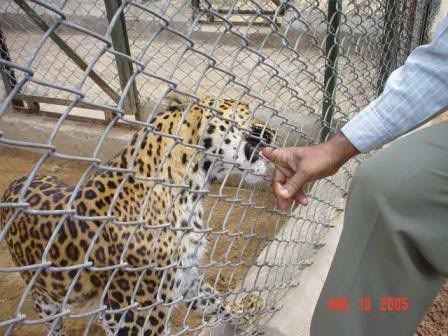 … …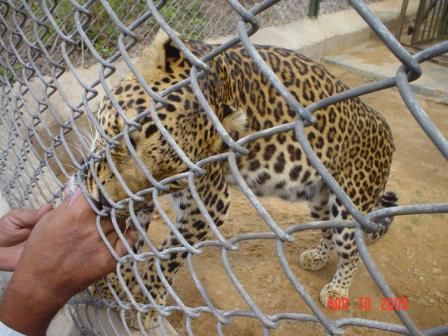
Jolly lovingly licks and sucks on Mr. Purohit’s fingers and hand
These strong vibrations of love touch us so intensely, so deeply that when Mr. Kamal asks us to offer our hands to her as well (if we dare), cautioning us of the leopard’s prickly, though harmless, tongue. Without any hesitation (surprisingly we are not surprised even now of our action,) willingly, we (Rula and I) offer our hands of trust and friendship to this so-called wild animal, a she-leopard, JOLLY. JOLLY does respond, keeping up the trust, by accepting our hands of friendship, licking and nibbling, asking for more. There is no thunder. There is no thrill. Most importantly, there is no fear. There exists only a feeling of affection and mutual trust. No man, no animal, nothing else exists other than the inter relationship between two levels of beings based on mutual trust.
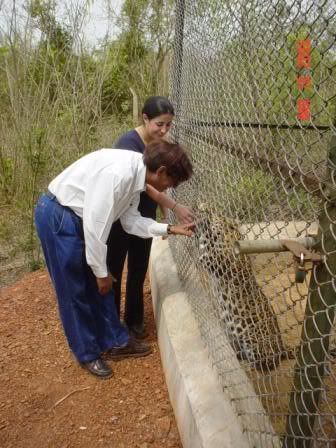 ... ...
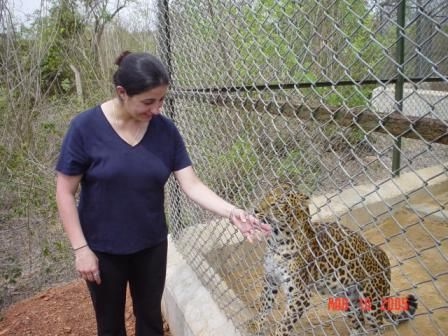
Ashok and Rula reciprocate the love and affection shown to them by beautiful Jolly
I wonder if this mutual trust can ever be established between man and animal when it is this very trust that is lacking between man and man. Somehow, forming such lasting and binding relationships between man and man seems a lost cause. The fear and mutual mistrust is what permeates man’s way of life and his approach to any other living being. This is what makes man and animal react so violently against each other. This is what makes man and man react so violently against each other. This is what is building up a fear psychosis.
Suddenly, I realize that JOLLY is in a cage, captured and captive. Charged by my own repressed emotions, I imagine locking up all of the so-called humans inside Jolly’s cage, liberating her and forcing them to experience the feeling of forced confinement. We come back with a great lesson on mutual trust and friendship. We come back more humanized, JOLLY, being our teacher.
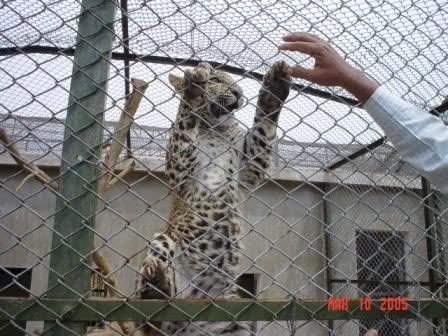 … …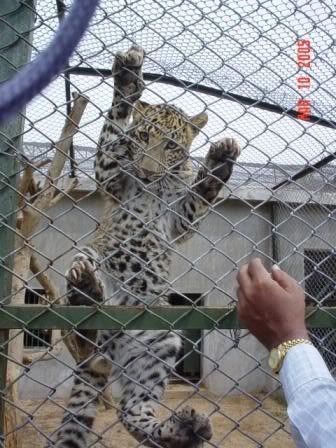
A baby leopard occupies the cage next to Jolly. This little one is feisty and full of life, and can climb faster than a squirrel can run up a tree
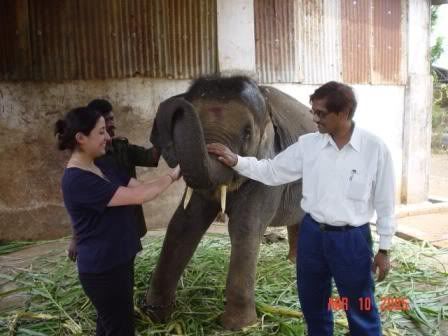
But that isn’t the end of our experience with endearing and loving animals. Next we greet two baby elephants (five years old each) and findd them to be extremely loving and receptive as well. One of the elephants does take a liking to Rula and begins to caress her with his trunk. Rula is taken with the elephants named ? and ? and we both regret ever having to leave this park which has given us the most beautiful experiences of our lives with animals.
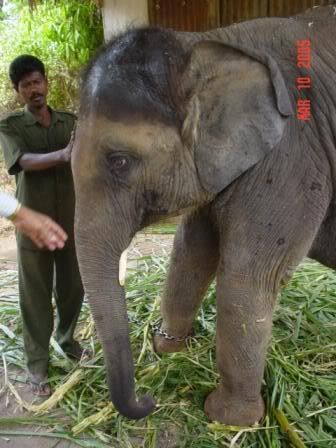
This baby elephant is so endearing, his face so cute and loveable and we cannot help but feel sad for his being chained, despite the humane and kind treatment he receives at this wonderful zoo park
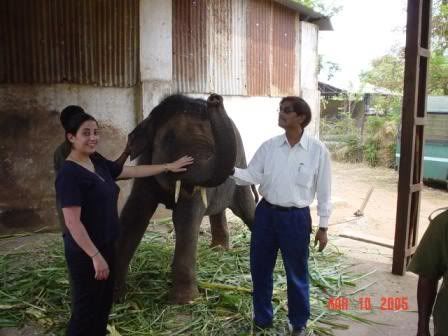 … …
This elephant is very sweet and is presently getting ready for his bath. He is chained just a few feet away from his little friend who is also going to be having his bath.
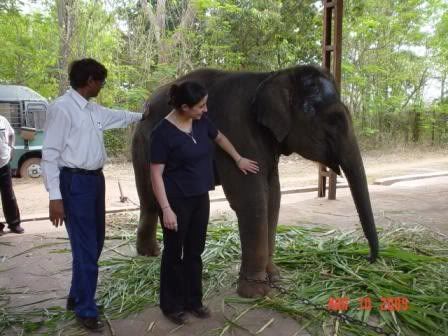
We move a few feet across in order to meet the elephant’s little friend, both are five years old
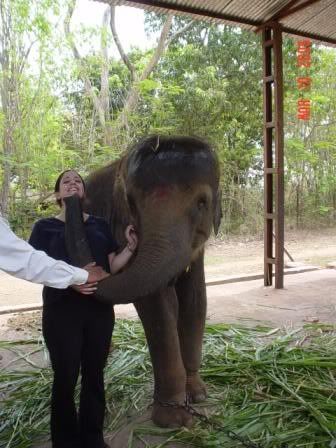
This little guy is so friendly and loving he actually gently caresses Rula with his trunk
Comments (1)
The Chimp Family: March 10th, 2005
04/19/2005 07:31 p.m.
They are three, a cohesive unit. The male, the companion, and a three year old child, a naughty little rascal. The male is huge. Coincidentally, it is their lunch time when we, Rula and I, walk to just outside their living quarters. Interestingly, almost all of the animals here in this lush green Nandan Kanan zoological park, have their own private quarters apart from open enclosures created to mimic their natural habitats. Now it is the parent’s turn to eat their lunch after the child has been fed. It is now his mothers turn to eat, and a forest guard feeds her with a spoon from a huge bowl through iron bars, while the father waits for his turn, clutching the bars in his large wide spread hands, looking relaxed. They are all standing against the bars interestingly, in order from right to left, the head of the family, the companion, and the naughty little son...
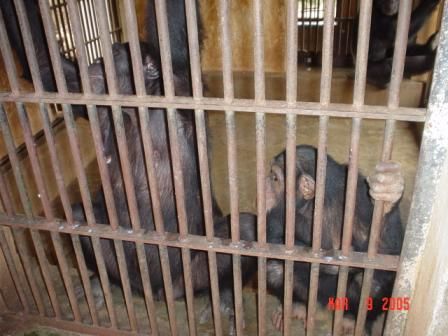
The little one finishes his lunch as mom gets excited for her turn.
Dad climbs the cage walls and hangs on the bars until he sees his son snatch
the spoon from the attendant and runs after him to administer a
loving dose of parental guidance in the form of a spank haha
The naughty boy, amusingly, snatches the spoon from the attendant while he is feeding the mother, and runs away to the other side of the cage, climbing and darting back and forth playfully. Like any other cohesive human family, the father and head of the chimp family runs after the boy, catches him, gives him a spanking, snatches back the spoon, and to our surprise, hands it back to the attendant. He calmly goes back to his posture waiting his turn to be fed, with his hands wide spread, holding the bars, looking relaxed. Yes, they are a family who can be role models for us so called human beings.
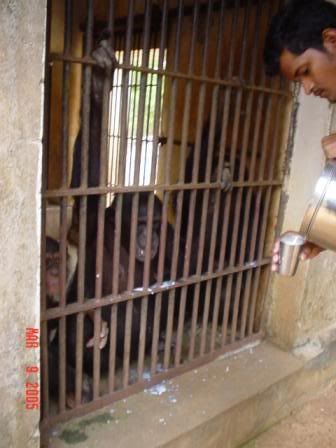
The Chimp Family from right to left: Father, Mother, and naughty son
The mother is now being fed as the father waits his turn patiently
After we visit the Chimp Family, we proceed next to the area where the park zoo keeps the beautiful and majestic white tigers. Throughout our tour we see that we are given special treatment and are allowed very close to all the animals. Essentially, we are allowed into the cages and right outside the cages where the feeders and trainers work each day. This is a great privilege for us as we get to see the rare white tigers up close and personal, almost too close hahahaha. The white tigers are found only one place naturally in the world, and that is on the Indian continent.
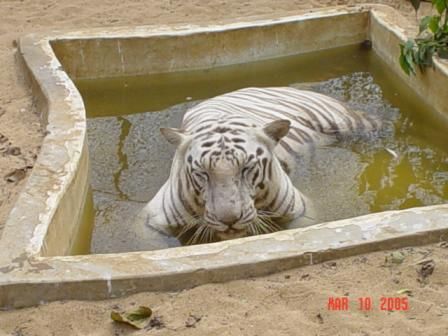 ... ...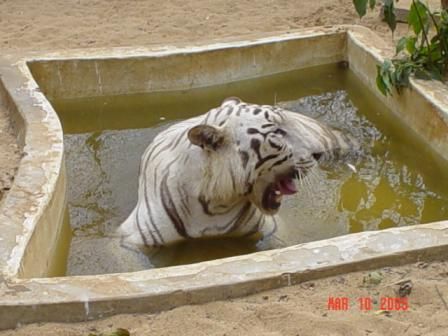
Standing directly outside the cages of the white tigers we watch this big guy as he relaxes in the cool water of his bath. Luckily, we even catch him in a big yawn!
Mr. Kamal informs us that this zoo park not only contains the most white tigers of any park in India, but also houses the only two white tiger babies to have been born naturally to two regular colored tigers. It seems that each of the tiger parents has a recessive gene and passed on this white tiger gene to both infants.
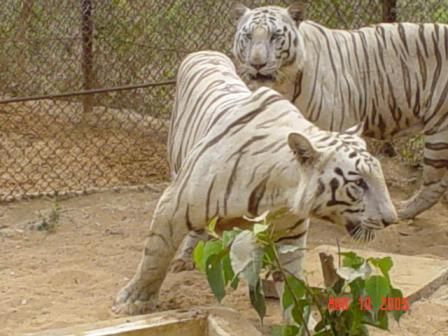
These two white tigers, presently in their cage, are restlessly pacing back and forth as they want to be let out into the open fields designated for them alone
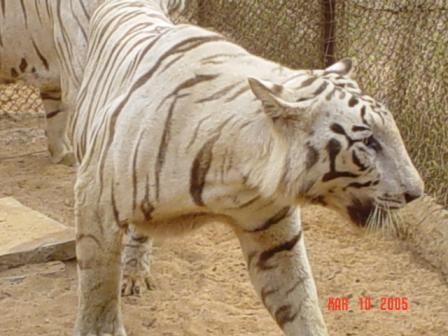
You can see how close we are to these beautiful animals, just a few feet away behind a wire fence
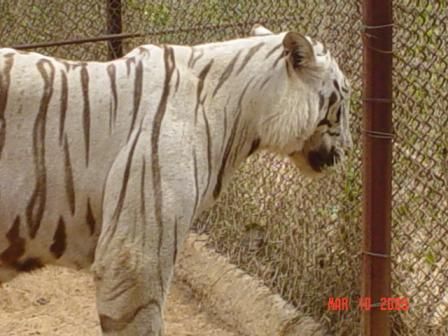
This tiger looks out upon the fields longingly, hoping his trainer, who has been training white tigers for over 17 years, will let him and his friend out soon to roam and play
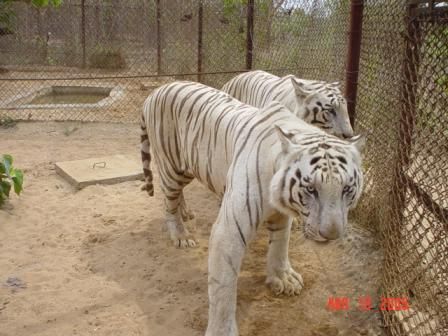
The tigers stand around in anticipation of the gate to the fields being open, meanwhile they sneak a peak at their awed observers
Comments (1)
Bini Falls in Love with Rula : March 10th, 2005
04/13/2005 10:21 p.m.
An orangutan’s face up close, like his namesake,
he looks like an “old man in the woods” (www.animaldiscovery.com)
Oh! Don’t be surprised, Bini does fall in love with Rula, and I am not surprised. I watch Rula rising in love, trusting, expressing her humility and affinity and feeling sad when she has to leave Bini. And Bini? She is as sad as Rula is, as any human being can be, watching Rula leave.
Bini, she is the great grand mom of the homosapiens, our immediate ancestors. Bini! Bini! Bini! She appears on the third call of our host Mr. Kamal Purohit, the assistant conservator of the Nandan Kanan zoological park. From a back door that leads out into an open enclosure where the visitors watch her huge form in awe, she walks slowly into the cage from where she is usually fed. She looks lonely, tired, and sad. She is 26 years old, and Mr. Kamal informs us that they are searching for a suitable mate for her, though the only male they recently negotiated as her companion died in his own zoo before being transported to Bini’s secluded home.
The moment she willingly enters her cage, we easily make out that her attention is concentrated on Rula. She extends her large hands through the iron bars as an offering to Rula, but for reasons of her bulk and strength, our host restrains Rula from responding.
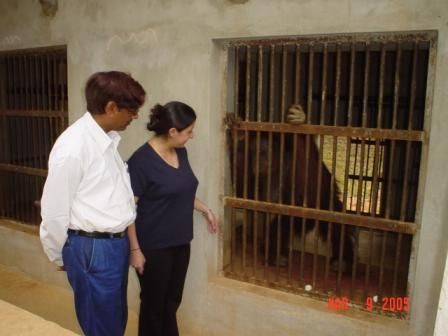
Ashok and Rula approach Bini’s cage. Bini stares at Rula from the very beginning
“You can touch and caress her,” he says, “but don’t get too close.”
“How about me?” I ask eagerly.
“Oh! Well, she may treat you as mice in the rice, so maybe you’d better maintain a safe distance. Ha! Ha! Ha!”
But I do caress her, though cautiously and maintaining a safe distance. She continues to extend her long arms through the bars to Rula, throwing her kisses by extending her pouting wide lips in Rula’s direction, wanting her to come close, wanting her to touch and hug. At this point, Bini’s lunch arrives and Mr. Kamal offers her a boiled egg that she peels, breaks, sucks out the yolk, and then throws away. Mr. Kamal picks up the egg white from the ground and gives it back to her to eat, though time and again she refuses to do so and simply throws it back down on the ground. Soon after, when Mr. Kamal offers her milk in a large steel cup, she refuses to drink. Mr. Kamal seems to understand the cause of her refusal to eat and asks Rula to feed her. To our surprise, Bini begins to drink readily and heartily all the milk from the cup!
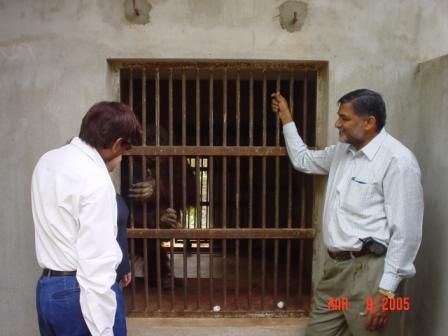
Before lunch arrives, Bini begins to extend her hand out endearingly
Bini continues to attract Rula’s attention by constantly extending her lips and expressing her affection, and affinity.
“Why is she so attracted towards Rula and not me?” I ask Mr. Kamal.
“Well, this has something to do with her childhood association,” he explains.
“She was brought here from Australia under an exchange program and for this reason has always been more at ease, more at home with fair-skinned people.”
Ha! Ha! I laughed within. She is so dark and like most of Indians, she too is afflicted by the typical Indian concept (complex) of beauty, wherein the fairness of the skin is the criterion for pronouncing someone beautiful, and dark ugly. Hahahahahaha! Well, I reiterate my decision to keep a safe distance from her as I realize she may feel irked at my attempts to attract her attention. She may treat my action of endearment as a cause of distraction. I look at her huge hands and feel safe from that distance though I just can’t resist caressing her one more time, though I remain alert and watchful of her reaction.
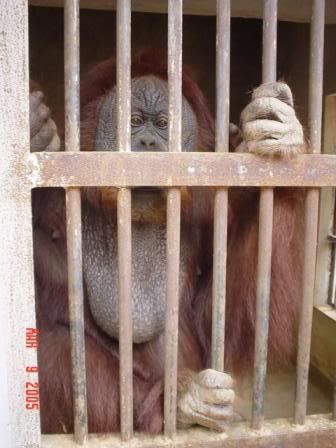
After lunch, Bini gets as close to us as she possibly can, and we too get as close as we can
Incidentally, Rula’s camera cells exhaust at this very moment and becomes a source of great frustration. Somehow, she manages to take a picture or two of this meeting with Bini, though we are unable to capture the moments of love and affection between herself and this grand and beautiful creature. As we begin to leave, Bini follows us to the outside enclosure. She looks so sad and so too does Rula since they both know that they have to part and these moments of love and affection, these moments of complete trust between man and animal will soon become a thing of the past, though an ever living association. Before getting into our car, we stop for a while to say our final goodbye.
Bini! Bini! Rula goes on calling her name, and Bini, in turn, continues to extend her lips in loving gesture. When we finally part with her, I watch Bini slowly walk back to her room as we climb back inside our car. I don’t think I can ever forget this grand old lady. She is so graceful, so endearing, and so human. A great sadness envelopes us.
PS: When I inform Rula of my intention of documenting ‘Experience Bini’
by way of this JE, this is how she remembers her:
“Sweet, lonely, sad little Bini. No, she wasn't little, but she did give one the sense of wanting to love her and take care of her, and in that sense she felt little...like a child, yes...a child – a grandmother...isn’t it odd how similar we become at these stages of life? We are, at these stages, both childlike and wise at the same time. Well, it was her eyes Ashok. She was looking at me as though she were asking me something, asking me to stay...asking for help, for love...asking for our moment together to last beyond what all moments with others have lasted. But she was as wise as she was childlike, and in the end she knew what would be. She knew that we would leave her, and that her wide enclosure was the smallest little cage in the whole world. But ashok, no one could ever imagine Bini as we saw her, I mean her eyes...so sad and lonely. I love her. I wish I can be with her again.”
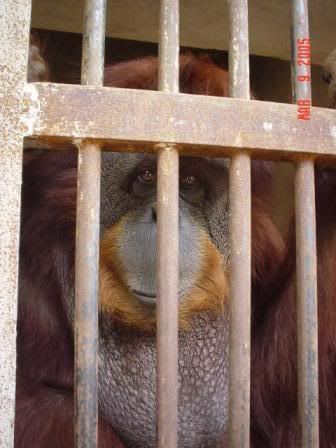
Bini’s sad and lonely eyes. This is the look we remember most…
PS: I read this humorous piece somewhere online:
“Orangutan” by Grandpa Tucker
We read about the monkey,
We read about the chimp,
But info on the orangutan
Is really very limp.
Their eating habits, where they live,
What causes them to smell?
Research ignores the orangutan
Because it's hard to spell.
It won’t be out of place here to add some basic information about this
endangered human ancestors, the orang-utan – called “person of the forest”
by local people and the “neglected ape” by many scientists.
Orangutans covered with long dark brown hair have a large bulky body, a thick neck, very long strong arms, short bowed legs, and no tail. They are almost as huge as Gorillas. Orangutans have senses very similar to ours, including hearing, sight, smell, taste, and touch. Their hands are very much like ours as well, and they can grasp things with both their hands and their feet. In addition, Orangutans make wonderful mothers, only human children stay longer with their mothers than orangutans!
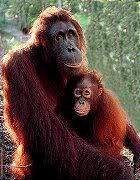
Princess and son Pan (www.orangutan.org)
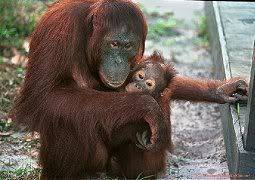
Davida and son David (www.orangutan.org)
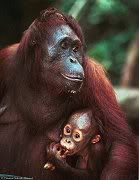
Ronnie and her infant (www.orangutan.org)
The largest males have an arm span of about seven and a half feet. They eat both plants and animals, although plants comprise most of their diet. Fruit is their favorite food as well as leaves, seeds, tree bark, plant bulbs, tender plant shoots, and flowers. Orangutans don't even have to leave their tree branches to drink, they drink water that has collected in the holes between tree branches.
Orangutans are very intelligent. They have been known to use found objects as tools. For example, they use leaves as umbrellas to keep the rain from getting them wet. They also use leaves as cups to help them drink water. Each evening, orangutans construct a "nest" in the tree branches for the night in which they will curl up and sleep. These nests are made out of leaves and branches and are shared by a mother and her nursing offspring. Sometimes, the orangutan will use a leaf as a "roof" to protect itself from the rain.
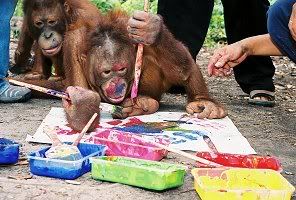
Having fun painting and even more fun getting it all over! (www.orangutan.org)
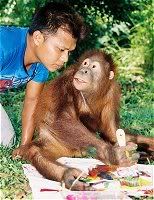
“What do you think of this?” (www.orangutan.org)
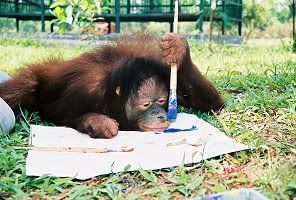
Concentrating REALLY well. Art is hard work! (www.orangutan.org)
Orangutans usually move by swinging from one branch to another. This mode of transportation is called brachiating. Orangutans can also walk using their legs (though they rarely do), and do not swim.
Orangutans live about 50 years in captivity, whereas their life in the wild spans only about 30-45 years. Like most animals, they live longer in captivity.
Comments (1)
A Date With CHILIKA-Day Two: We Walked On Water: Mar. 9, 2005
04/05/2005 09:28 p.m.
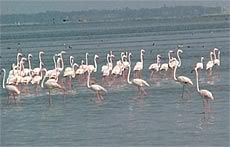 PINK AND WHITE FLAMINGOS PINK AND WHITE FLAMINGOS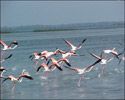
(orissatourism.org and chilika.com)
The ferry is there but it isn’t. It simply does not fit into my image of a ferry. So, while waiting for this convoy to appear I ask my driver, “Where’s the ferry?” He points to a small vessel tied to the dock, and I begin to wonder how this boat can possibly be called a ferry, let alone accommodate our car? For not only is our car traveling on this boat, but so is a bus with all of its passengers occupying their seats, apart from many more on foot, bicycles, and motorcycles. After the bus drives onto the ferry, our driver squeezes us in directly behind it as Rula and I sit anxiously in the back seat. We watch as the ferry operators calmly adjust the back of the craft by leaving the sluice gate open since, after having the bus on board, there is hardly any space for the car. Needless to say, the rear of our car is placed on the chained sluice gate rather than on board, though the crew do us the favor of raising the sluice gate an inch so that the car does not roll back into the lake with me and Rula inside it! (Hahahaha)
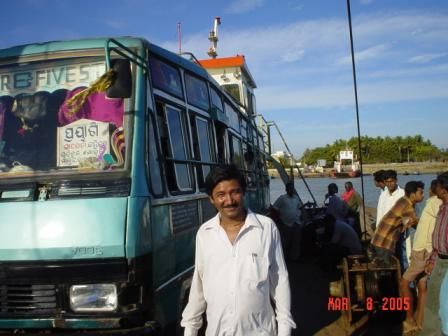
Our ever-positive and loyal driver smiling on the ferry after he parks our car behind the bus
Our rendezvous with CHILIKA is not yet over. After spending three hours on that makeshift motorboat (an uninstalled small engine left loose on one end of the boat attached to a submerged fan through a long rod which makes the fan rotate. This is a simple indigenous device that propels the boat. The boatman just moves the rod towards the desired direction in order to direct the boat to its desired destination. Yes, this is almost like a 2000 BC boat and mind it, the boatman too belongs to the same era in both appearance and behavior Hahahaha) and having spent some time in that museum exhibiting CHILIKA’S ways and lives, we are to take this ferry to a place which is 10 miles on the other side of the lagoon where we are booked for the night. In the beginning, we remain seated in the car despite that we are on the ferry. My reason for remaining seated is simple as there is hardly any space on my side of the ferry to open the door without facing the risk of practically falling into the lake. But Rula is a courageous woman. She not only manipulates her small frame out of the car on the ferry, but she also starts taking pictures. Her courage encourages me to get down from the car and enjoy this one hour ride in the ferry which goes without saying, is an experience in and of itself.
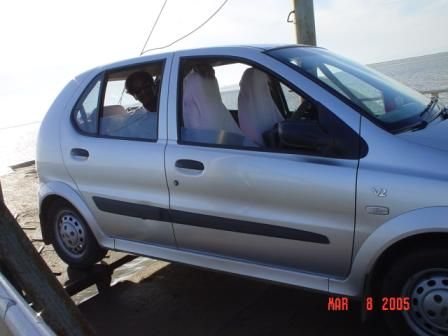 Don't look down... Don't look down...
Ashok sitting in the car contemplating his position as the back tires hang by the sluice gate chain since the gate cannot be properly closed
I assume that we are on a 30 to 45 minute drive from this side of Chilika lagoon to our hotel based on the information we receive after disembarking the ferry, yet this is not so. The road conditions make this 70 mile drive seem more like 700. I remember joking with Rula while I was driving on such a road on way to KANHA, the famous wild life sanctuary, that I could beat her husband in a car race (I intentionally replaced Schumacher with her husband) any time I want on these roads (her husband is fond of car racing). Well, we arrive at 8.30, have our dinner together, and retire a bit early to our respective rooms.
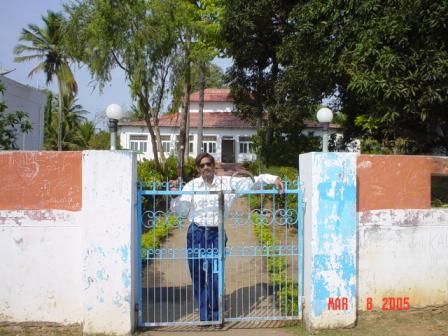
Ashok in front of the government owned and run hotel we stay at in Orissa
We have one more date with CHILIKA on that beautiful day-to-be, the 9th day of March, 2005. We hire a boat from the hotel guide (to my surprise it is a 21st century motorboat) to a destination that is to become a lifetime experience for both Rula and I. Apparently, we are to visit the famous migratory bird sanctuary situated 10 miles off the coast on an island known as Nalban.
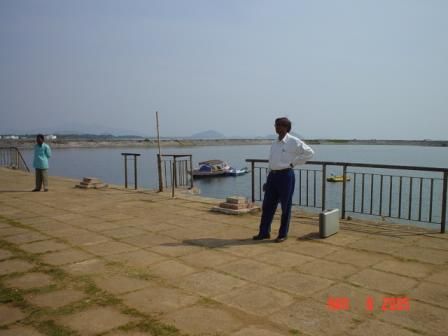
Ashok waiting at the dock outside our hotel for the motorboat that will take us to Nalban Island, otherwise known as, the Bird Sanctuary
An Island is what we are told this bird sanctuary will occupy, and an island is what we look for. But thirty minutes into our ride in the motorboat, watching occasional water birds with our eyes and through binoculars, the boat comes to a halt in what seems to be the middle of the lake. What a scene to behold! We can see miles of green, carpeted lakebed (unlike the muddy waters we had seen the previous day) and rows and rows of ducks, flamingos and a huge lonely pelican. By the way, 948 hundred thousand migratory birds visit this very place this year. The ducks are from Siberia, the flamingos from Australia, and among them that lonely native pelican. The Australian flamingos are almost four feet tall, but in these clear waters their reflections make them appear almost double their height as we watch in amazement from a three furlong distance away. But where is the island? “How far is the island?” I ask the boatman. ”This IS the island,” he replies to us laughing. Then, to our surprise, he points to the great expanse and tells us to get into the water and take a walk. Walk? Walk where, I wonder? Walk in the middle of this vast expanse of water? The question does not arise. At least, not in that marshy lake that is almost part of the sea. In any case, the boatman is considerate and my driver amiable and courageous. The boatman tells his assistant to walk through the water and make those white and pink big flamingo’s fly so that we may take a few good pictures. The assistant boatman, along with my car driver, fold up their pants, get down from the boat, and start strolling towards the birds as if they are walking on the surface of the lake! “Be careful!” is all I can think to say to them and this is precisely what I yell out.
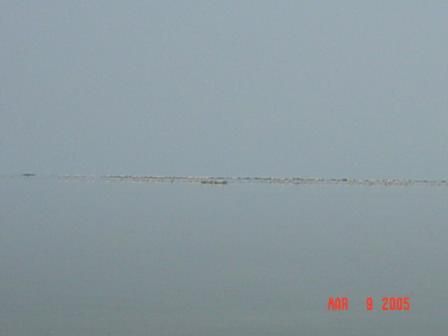 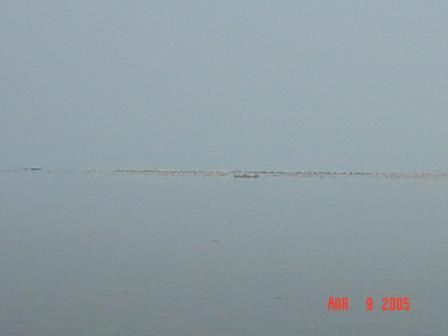
Hundreds and hundreds of pink and white flamingos, the last flocks to leave Chilika and head home for the summer, walk on the water all along the horizon
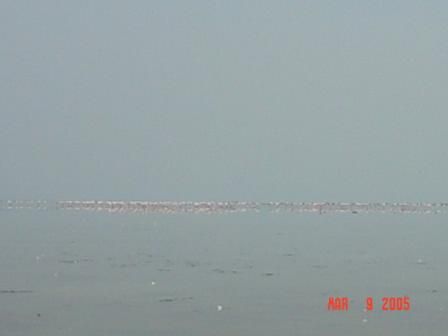 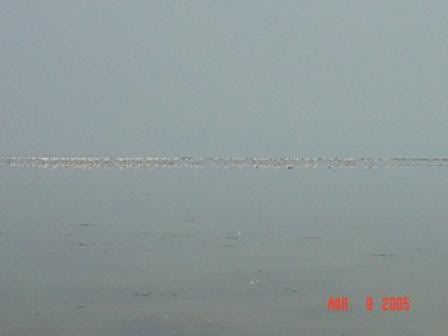
Four-foot flamingos seem eight feet tall as their reflections glisten under the sun against the lagoon’s surface
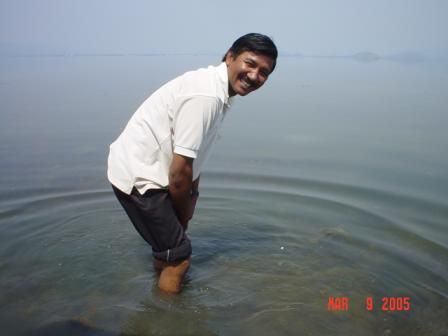
Our driver bravely steps out onto the surface of the water
But to my surprise and increasing adrenaline, I find this courageous woman Rula shin folding her pants up. Oh no! I think, but helplessly I too roll up my pants. What else can I do? I cannot leave her to walk in those waters all alone! So, hand in hand we get down from the boat in the middle of this marshy nowhere in the middle of this vast expanse of water, and commence walking towards the migratory birds. This reminds me of Jesus walking on water when his disciples thought he was a ghost. We both recollect this biblical episode and laugh. But we do walk like Jesus, though there is not one disciple of ours to pronounce us the children of the God. So, we remained children of men though walking on the water in the middle of that vast lake the span of which is 1100 plus kilometers. By the way, it isn’t just us watching the migratory birds, but the birds too are watching us and begin walking away from us, step in step at the same pace we are walking towards them. But our crew, my driver, and the assistant boatman, do succeed in making them fly and Rula is lucky to capture with her camera these beautiful white and pink flamingos in the open sky over this green lakebed. This experience of ours is most beautiful I can ever recall up to that moment. This was a lifetime experience for us both.
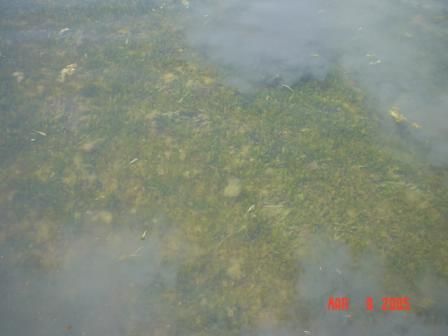
This is the middle of the lake and how the water and marsh look beneath our feet
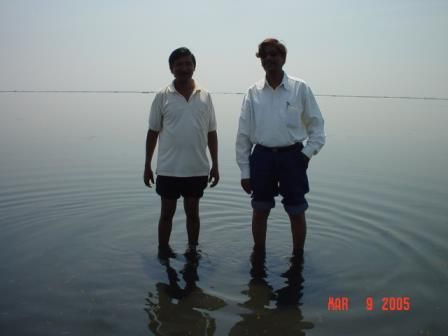
Ashok and the driver walking on water
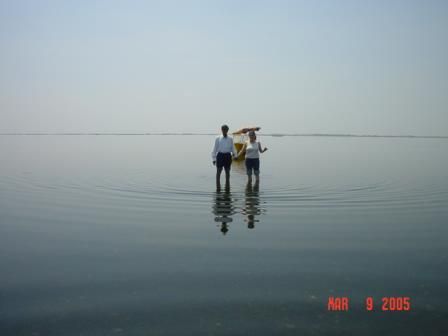 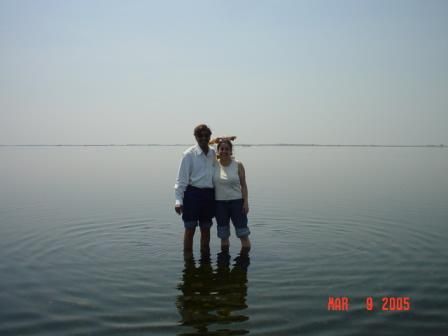
Rula and Ashok braving to walk on water and enjoying every moment
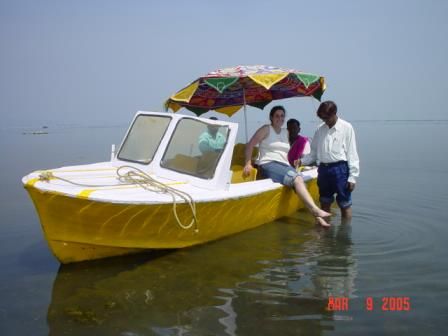 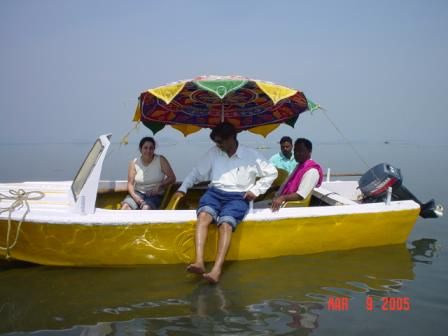
We wash our feet before getting back into our motorboat and heading back to our hotel
PS: I came across a poem titled, “Jesus Walking on Water”
While apostles were out fishing
A storm rose on the sea
We're told within the Bible
'Twas the sea of Galilee.
Christ stood by the seashore
He talked to apostles too
He went walking on the water
He showed them what He could do.
He bade one out to dress himself
And meet Him on the sea
The apostle was so fearful
On this sea of Galilee.
Christ saw him as he was sinking
He needed more faith we know
Just like we are of today
While through perilous times we go.
Look up toward the heavens
And make your burdens known
He'll give more faith if one will,
For Jesus knows His own.
............
Yes, Rula showed what she could do. Hats off to her.
Comments (1)
A Date With CHILIKA: March 7, 2005
04/04/2005 09:34 p.m.
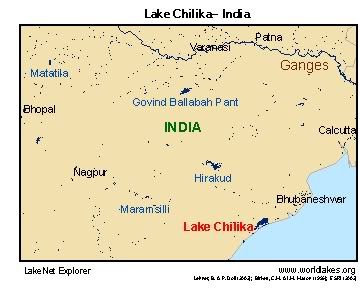 The Lake Zoomed In The Lake Zoomed In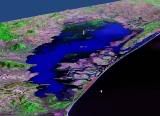
(worldlakes.org and pbase.com/hcarlsen/india2005maps)
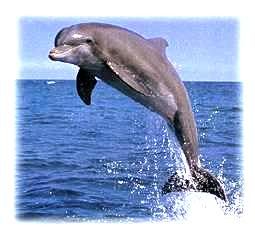
The water is muddy, a bit perturbed, and this huge lake looks just like a sea. We can outline, on the horizon, the distant islands dotted with coconut and palm trees. Our boat is an ancient vessel turned into a makeshift motorboat, its boatman likewise appearing ancient though not wise, but rustic and uncouth. We, Rula and I, are here to watch sweet-water dolphins swim and play, and then to ride to the point where this lake meets the sea. This point is known as 'the mouth'. I wonder how this lake water remains sweet though it meets the sea at a certain point? Maybe the different densities of the water keep them separated, I think to myself.
 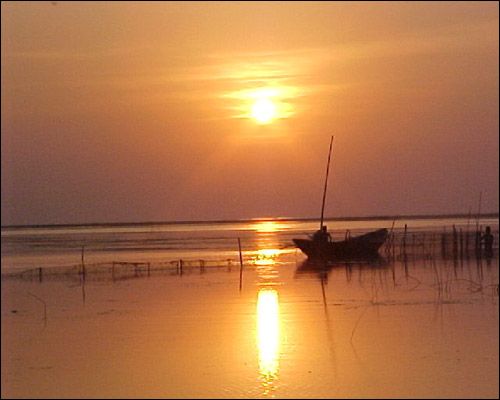
(chilika.com and verobeachsold.org)
This is the famous CHILIKA LAKE, a shallow marshy lake and the largest lagoon on the eastern coast of India and the subcontinent. Chilika Lake is roughly pear-shaped and fluctuates in size according to the dry and wet seasons. Varying in length between approximately 600 and 1200 square kilometers, its width spans about 32 km at its broadest. Nalaban, one of its biggest islands, is a 10km marsh which is submerged underwater during July and March, but is a major feeding and roosting habitat during the winter for over a hundred species of migratory birds who arrive in October from their temperate breeding grounds. These birds include a few species of Australian flamingos, over a dozen species of ducks, and several migratory birds from as far away as Siberia and Mongolia. Due to the varying degrees of salinity in different parts of the lake, the fauna is interestingly diverse, with a variety of animals adapting to a marine (or riverine) existence in order to survive in different parts of the lake. Animal life recorded in the lake ranges from microorganisms to a vast variety of fish, which together sustain the migratory birds’ population in the wintertime.
A few estuarine turtles and snakes are found here along with species of dolphins, otters and several rodents, bats and sloth bears on the hills. Around 158 species of fishes and prawns have been recorded so far. In 1917, a rare reptile, the limbless skink (a type of lizard) was discovered for the first time in the loose soil of the Barakudia Island.
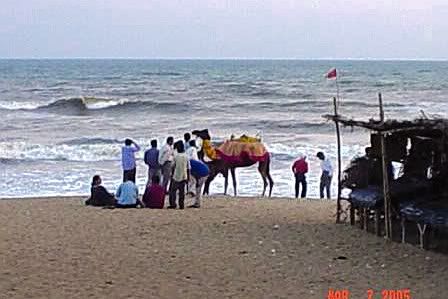
I bring Rula here after having visited the famous SUN Temple of the thirteenth century called Konark Temple. This temple is widely known not only for its architectural grandeur, but also for the intricacy and profusion of its sculptural work. The entire temple has been conceived as a chariot of the sun god with 24 wheels, each about 10 feet in diameter with a set of spokes and elaborate carvings. Seven stone horses drag the temple. Guarding the entrance are the statues of two lions (symbol of wisdom), atop and crushing two elephants (symbol of wealth), which are in turn atop and crushing two men (symbol of idiocy). This temple we visited after having spent some time on one of the largest beaches in India called PURI.
 And And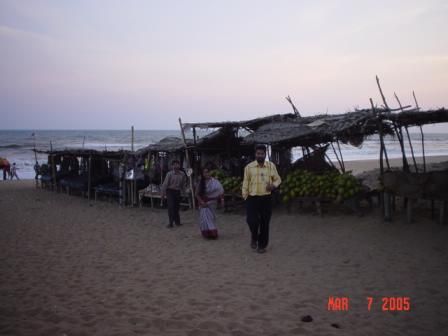
A lovely scene at Puri beach
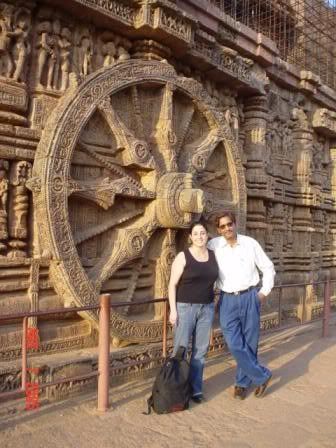 Longer View Longer View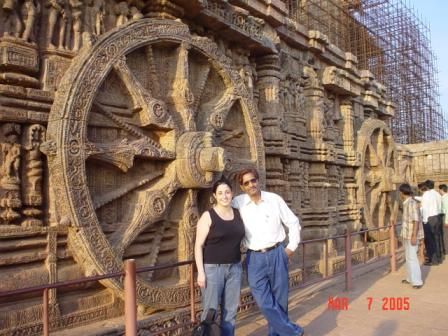
Rula and Ashok at the Konark Sun Temple - One of 24 Wheels - 2 each of 24 dedicated to one Zodiac sign, in this case, Pisces
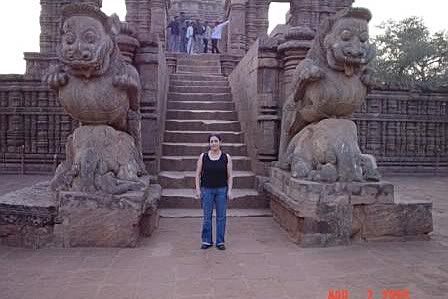
Rula at Konark Sun Temple Entrance - Two Lions guard the entrance (symbol of wisdom),
crushing elephants (symbol of wealth),crushing men (symbol of idiocy)
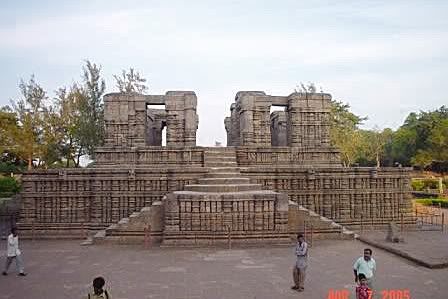 Cut View... Cut View...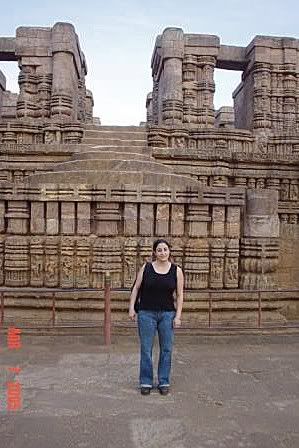
Across from the Sun Temple lies this beautiful stage built exclusively for women to dance to their Gods.
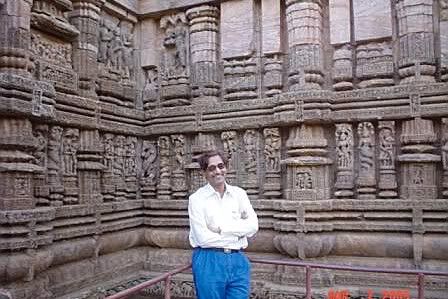
Ashok with a smile at Konark
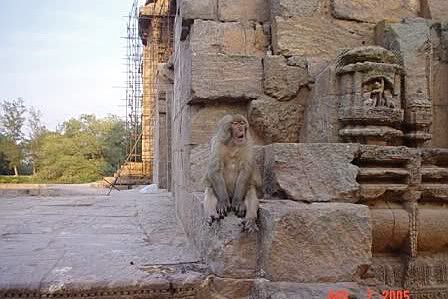
One of the many monkeys who call Konark Sun Temple their home. He sits above and before a group of men about to make his emotional speech
It is almost noon on this 8th of March, 2005, a time, we are told, is not ideal for dolphin watching as the bright sun and heat keep the dolphins from appearing on the surface of the water. Over and above, it is a bit windy, again a factor not conducive for dolphins to appear on the surface. To our pleasant surprise, we do see dolphins in large numbers despite the bright sun and wind, though their appearances are infrequent and short. In the beginning we spot only one dolphin at a time, but subsequently they oblige us by appearing in two’s and then three’s and fours, shoulder to shoulder, rolling over and over and over again on the surface, swimming together in perfect harmony. But we do miss those jumps wherein dolphins virtually stand on their tails, their bottlenoses facing the sky.
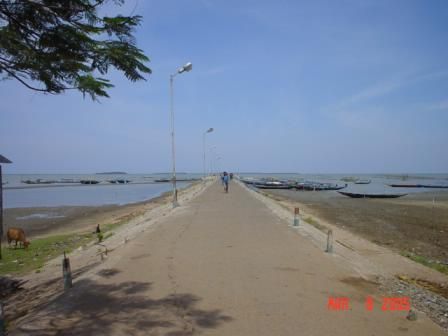
Walking on the dock towards the boat that will take us dolphin-seeing with a final destination to the mouth
The dolphins appear and disappear on the surface of that sweet water muddy lake so fast that no sooner is Rula’s attention attracted and her camera set to capture them do they simply disappear out of sight. After many unsuccessful tries, Rula thinks of a trick when she finds an opportunity: four dolphins appear together in one particular spot, rolling over in perfect unison. Rula decides to follow them through the eyes of her camera and click on any cue. A dozen clicks on her part result in two clear pictures and we are so happy with these captures.
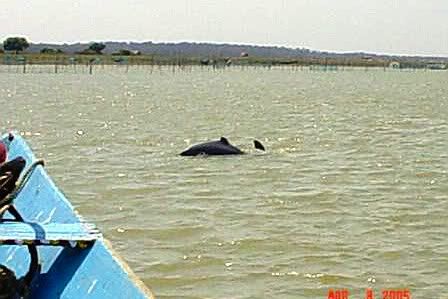
We spot one dolphin swimming around alone
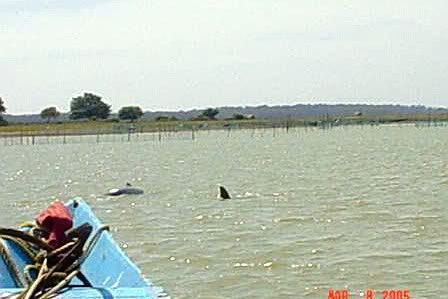
Here we spot two dolphins traveling together
After our rendezvous with the dolphins, our makeshift motorboat turns toward the spot where the lake meets the sea. An hour’s ride brings us to what is known as the mouth of the sea where a shallow embankment separates CHILIKA lake and the Indian Ocean. Still, despite being separate entities, they did meet externally as well as internally and the water, their essence, did mix. The merging of lake and sea we confirm through the documentary film we later view in the museum of the CHILIKA Development Authority. Over time, this mixing of saline and sweet water has increased the marine life many folds. Bio-diversity not only improves the quantity of sea creatures, but also the quality. (From our point of view we need the quality and not the quantity. Ha! Ha! Ha! )
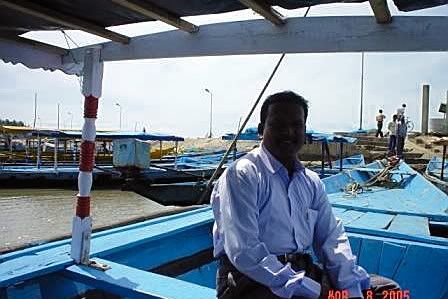
Our honorable guide, Mr. Jena, a school teacher
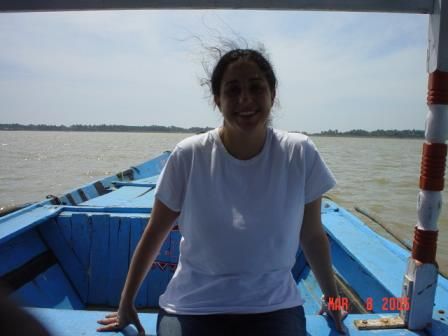 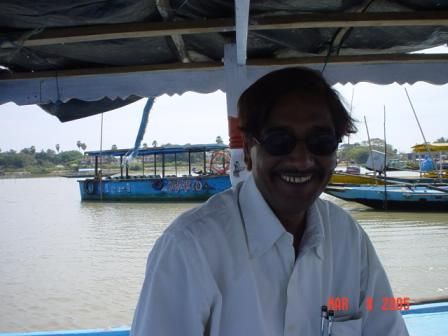
Rula and Ashok on the ancient motorboat on the way to the mouth
When the boat stops at the mouth and we land on a piece of landmass, the lake lies behind us and on our left side with many lush green islands on the horizon. The sea, with its incessant clamoring waves, is in front of us infringing the embankment separating it from its beloved CHILIKA and rising with a landscape on our right side with casuarinas planted not very long ago on the scale of time. Here there were few vendors selling coconut water, fried fish, and tea for the visiting tourists, although the area looks almost deserted, as if visitors are few and far between.
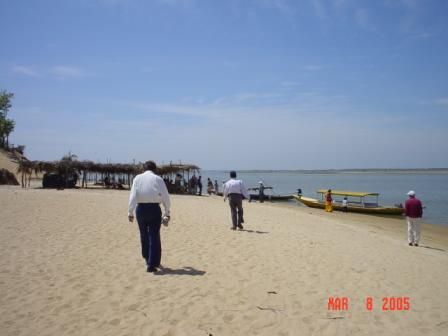
On the way back to our makeshift motorboat we decide we will make a stop at the vendors' tents
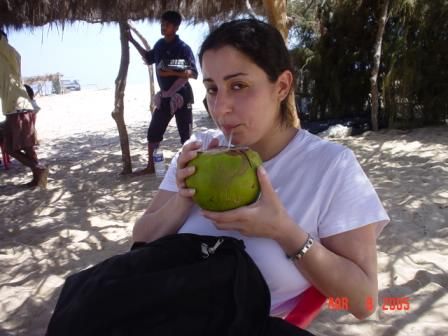 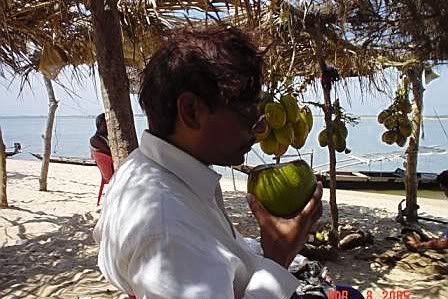
Rula and Ashok sitting under the vendors' tent enjoying the cool refreshing milk of a coconut
We sit beneath the tents and sip on cocunut milk on our way back from visiting the mouth's beach. But on our way in, about one hundred yards past the vendor's tents, we walk towards the the sea, and what a landscape lays before us! On our right side is a huge desert-like beach, yes beach, which looks just like a huge desert with rolling sand dunes! Instantly, I decide that this could be the largest beach on earth and a site that would attract millions of people every year if only those at the helm of affairs knew how to sell it as those who know how to sell the Grand Canyon do. (Ha! Ha! Ha!). The beach is so gigantic that I wonder how people swarm on other tiny dirty beaches while here we were just three people enjoying such vast beauty - me, Rula, and our honorable guide, a school teacher, Mr. Jena, who is accompanying us by the courtesy of my friend Mr.Panigrahi, the director of the regional TV station and our host in this eastern part of India.
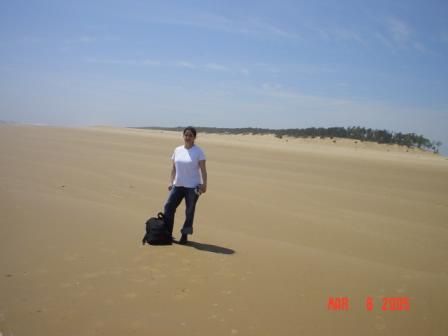
The beach looks like a desert when one does not look to the shore, for to the right the dunes stretch out as far as the eye can see
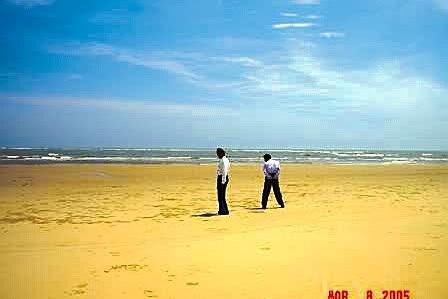
Ashok and Mr. Jena walk along the desert-like beach - The mouth where the ocean meets Chilika Lake Lagoon
It is here, as we stroll the dunes of the beach, that I find a prized gift from nature. I upturn a flat, yet somewhat curved piece of a curious-looking object that turns out to be one side of a sea turtle’s shell. I dig out yet another piece and find the bone structure of its neck. Finally, I find my gift a few feet away – his skull, perfectly intact and huge! I wonder how I will carry it from here back to my home where I will display it in appreciation? Mr. Jena, my honorable guide, comes to my aid by offering me a newspaper he is carrying tucked under his arm. We wrap it up and carefully put it in Rula’s backpack for safekeeping until we return to our hotel. By the way, I later gift this skull to my friend back in Bhubaneshwar on a promise that he will try to find one for me, and in turn, gift it to me.
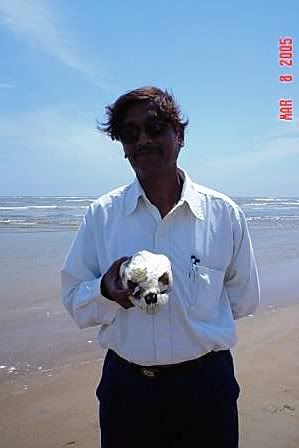
Ashok finds the remains of a turtle and shows off the skull which remains in excellent condition, just a few feet from the broken shell
While reading on dolphins I came across this poem by Horace Dobbs:
Pushing through green waters
Symbol of joy
You leap from the depths
To touch the sky
Scattering spray
Like handfuls of jewels
Not caged by union rules
Unfettered by sales targets
No trains or planes to catch
Your time is set by the flow
Of the sea's tides
And the moon's glow
You give us images of ecstasy
That we lock away
Behind the doors of memory
For quiet moments
when released from our possessions
We dream of a freedom like yours
Comments (3)
Next 10 Entries - Previous 10 EntriesReturn to the Library of Ashok Sharda
|